
How to Build Decision Frameworks That AI Models Use to Evaluate Your Market
A feature comparison table is not a decision framework. This playbook shows how to build the scoring rubrics, checklists, and decision trees that AI models adopt when advising buyers in your category.

Executive summary
When a buyer asks an AI model “how should I evaluate cybersecurity platforms?”, the model needs a framework to structure its answer. If you have published that framework (named criteria, clear priorities, an evaluation method), the model adopts it. You are no longer competing within the evaluation. You are shaping it.
Most companies publish feature comparison tables instead. Those help a buyer who already knows what to compare. A decision framework helps a buyer who does not yet know what questions to ask. That is the buyer AI models are advising, and that is where the authority is won.
This playbook covers the three framework formats, how to extract the right criteria from your Seedli data, the page structure that makes frameworks citable, and a worked example from AI-native cybersecurity where the Decision Clarity score of 62/100 tells you the market is wide open for someone to define the evaluation rules.
The feature table is not a framework
Open any SaaS website and look for their “how to choose” content. You will almost certainly find a feature comparison table. Three columns. Checkmarks. A pricing row at the bottom. The company’s column has the most checkmarks.
This is not a decision framework. It is a sales tool disguised as buyer education.
A feature table answers the question “what does each provider offer?” A decision framework answers a different question: “how should I think about this decision?” The distinction matters because AI models are answering the second question far more often than the first.
When a CISO asks ChatGPT “what should I look for in an AI-native cybersecurity platform?”, the model does not produce a feature grid. It produces a list of evaluation criteria, ordered by importance, with context about why each one matters. It builds a framework on the fly, assembled from whatever structured sources it can find.
If you have published that framework, the model does not need to improvise. It has a source to cite. And the criteria it recommends buyers evaluate on become yours. The difference between visibility and positioning is explored in why visibility scores miss the decision structure that actually wins buyers.
The difference in practice:
Feature table
“We offer real-time threat detection, automated response, and 24/7 SOC support. Competitor A offers real-time detection but no automated response. Competitor B offers automated response but limited SOC hours.”
Decision framework
“When evaluating AI-native cybersecurity platforms, prioritise these criteria in order: (1) detection-to-response latency under real attack conditions, not lab benchmarks; (2) regulatory alignment with your specific compliance obligations; (3) independence from consulting revenue that could create conflict of interest in incident response. Here is how to assess each one, and here is what good looks like.”
The feature table tells the buyer what you sell. The decision framework tells the buyer how to think. AI models reach for the second because it is the one they can adopt and reuse across every conversation about your category.
The framework format you choose depends on the decision type your buyer faces. A CISO evaluating platforms needs a different structure than a marketing director choosing agencies.
Three framework formats and when to use each
Decision frameworks are not a single format. There are three, and each serves a different buying context. Most companies should start with one and expand later, not try to build all three at once.
1. The scoring rubric
Best for: complex, multi-stakeholder decisions
A table of criteria, each with a definition, a weight, and a scoring scale. The buyer fills it in for each provider they are evaluating. The output is a weighted score that resolves disagreements between stakeholders by making the evaluation criteria explicit before anyone starts scoring.
This is the most powerful format for AI citation because it gives the model a complete, structured evaluation system it can recommend directly. When a buyer asks “how do I compare cybersecurity platforms?”, a scoring rubric is the format the model is trying to produce.
Start here if: your category has five or more decision criteria and buying committees with competing priorities.
2. The evaluation checklist
Best for: qualification and shortlisting
A list of questions the buyer should ask every provider, with guidance on what a good answer looks like. Less structured than a scoring rubric, easier for buyers to adopt immediately. The format works as a “five questions to ask before choosing a [provider type]” piece.
AI models surface checklists when buyers are at an earlier stage: not yet ready to score providers, but trying to build a shortlist. The checklist helps them decide who to evaluate further and who to eliminate.
Start here if: your buyers are overwhelmed by options and need a way to narrow the field before they evaluate in depth.
3. The decision tree
Best for: conditional, branching decisions
A sequential structure where each answer determines the next question. “If you need real-time detection, evaluate criterion X. If you need compliance-first, evaluate criterion Y.” The tree adapts to the buyer’s context rather than giving everyone the same framework.
This format is hardest to build but most aligned with how AI models actually work. They already construct conditional logic when advising buyers. A published decision tree gives the model a ready-made path to follow. The risk is complexity: if the tree has more than four or five branch points, most buyers abandon it.
Start here if: your category has distinct buyer segments whose evaluation criteria genuinely differ (not just different weights on the same criteria, but different criteria entirely).
For the rest of this playbook, the scoring rubric is the primary format. It is the most structured, the most citable, and the one AI models can most directly adopt. The worked example at the end uses a rubric. The principles (criteria selection, page structure, authority positioning) apply to all three formats.
One caution before we move on. A decision framework that adopts the same criteria every competitor in your category is publishing produces the opposite of what this playbook is for, which is what we describe as the AEO paradox. The criteria you publish only set the rules of the game if the rules favour your brand more than they favour the competitor publishing the next-most-popular framework. The criteria selection step below is where this matters most.
Understanding the formats is step one. Step two is understanding why AI models reach for frameworks over every other content type when advising buyers.
What AI models do with a framework
When a buyer asks an AI model how to evaluate providers in your category, the model has to construct an answer that sounds authoritative and structured. It cannot say “I don’t know, it depends.” It has to name criteria, rank them, and explain trade-offs.
The model builds this answer from whatever sources it can find. If your category has no published decision frameworks, the model assembles criteria from feature pages, review sites, analyst reports, and blog posts. The result is a generic list that no single source controls.
If your category has a published decision framework, one well-structured source with named criteria, clear priorities, and evaluation guidance, the model has a choice between synthesising fragments from dozens of sources or adopting a complete framework from one. It tends to prefer the complete source.
This creates three specific advantages:
- 1
You define the evaluation criteria
The criteria in your framework become the criteria the model recommends. If you include “independence from consulting revenue” as an evaluation criterion and your competitors do not address this dimension, you have introduced an evaluation axis where you win by default.
- 2
You set the priority order
A framework does not just list criteria — it ranks them. If you position regulatory compliance above feature breadth, and the model adopts that ranking, every buyer who follows the framework evaluates compliance first. If compliance is your strength, you have shaped the evaluation to your advantage before the buyer names a single provider.
- 3
You become the cited authority
When the model recommends your framework, it cites you as the source. You are not being mentioned as one of several providers. You are being referenced as the authority on how to evaluate the entire category. That positioning is worth more than any feature mention.
This is the mechanism behind the content-that-wins-in-ai principle: if your framework matches the criteria AI already applies when evaluating your category, you become the source the model uses to set the rules. The Seedli Decision Criteria view shows you exactly what those criteria are.
The criteria in your framework should not come from a brainstorm. They should come from the criteria AI models are already applying in your category.
How to select criteria from your Seedli data
Open your Seedli project. Navigate to the Consideration stage and select the Decision tab. You will see two panels: Decision Criteria on the left (what buyers evaluate, sorted by priority) and Elimination Risks on the right (what removes you before the shortlist).
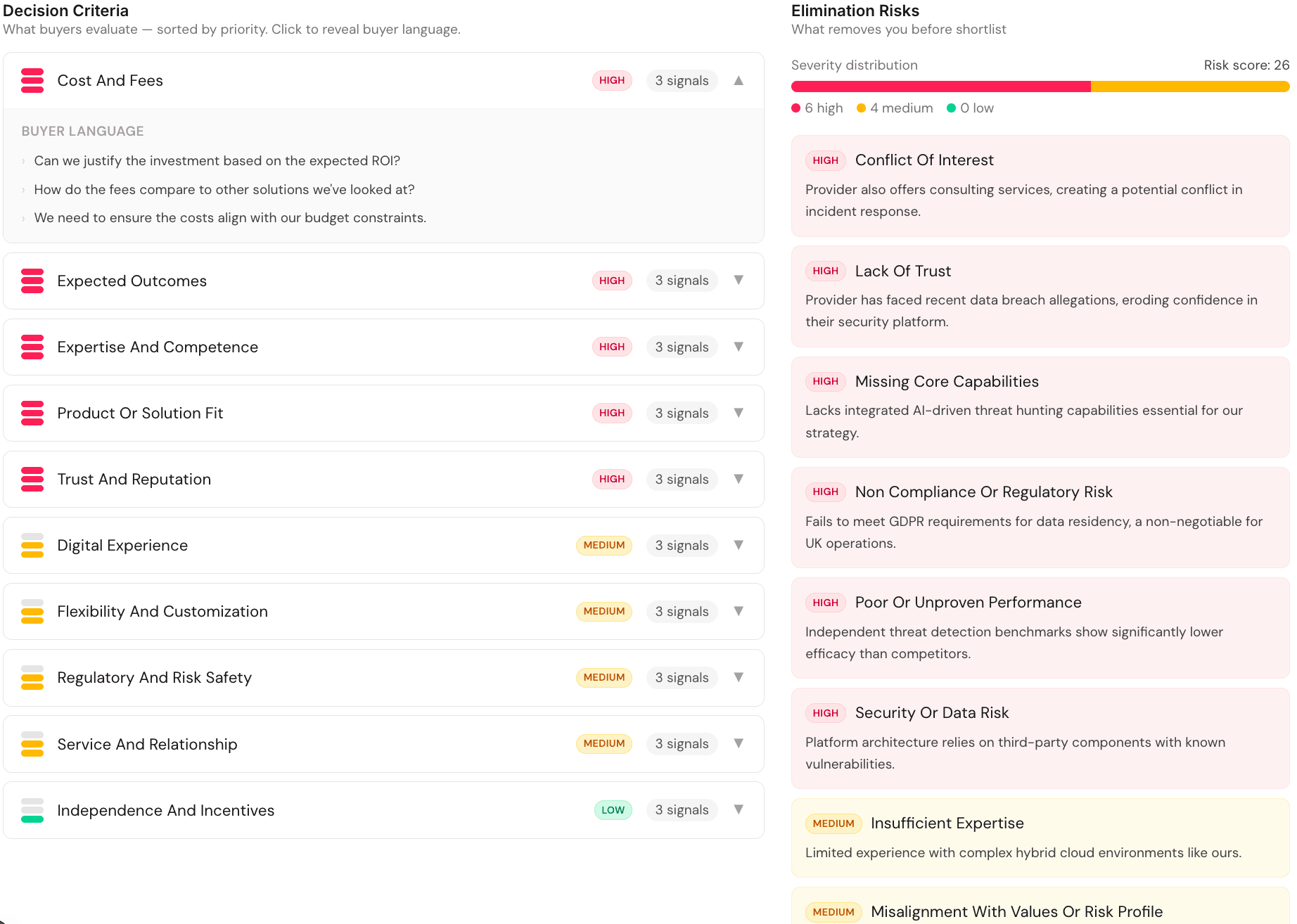
The summary bar above these panels gives you the Decision Clarity score, a number from 0 to 100 that measures how clearly AI models in your market agree on what the buying criteria are. This score tells you how much opportunity you have.
Reading the Decision Clarity score
Below 50: AI models in your market disagree significantly on what matters. Publishing a framework here is high-impact because you are filling a vacuum. But it also means the criteria landscape is unstable, and your framework may need updating as the market matures.
50–75: Moderate clarity. Some criteria are established, others are contested. This is the sweet spot for frameworks: you can anchor on the established criteria (validating what buyers already believe) while introducing new dimensions where you are strong.
Above 75: High clarity. AI models largely agree on the criteria. A framework here needs to match the consensus closely or it will be ignored. Your leverage comes from how you define the criteria (what “good” looks like), not which criteria you include.
With the Decision Clarity score as context, work through the criteria list using this process:
- 1
Include every high-priority criterion
These are non-negotiable. If AI models rank a criterion as high priority, your framework must address it or buyers will notice the gap. In the cybersecurity example, that means Cost and Fees, Expected Outcomes, Expertise and Competence, Product or Solution Fit, and Trust and Reputation all appear in the framework.
- 2
Select medium-priority criteria strategically
You do not need to include every medium criterion. Choose the ones where you have a defensible position or where the criterion is underserved by competitors. In cybersecurity, Regulatory and Risk Safety is medium priority but critical for compliance-sensitive buyers, and it connects directly to the elimination risk “Non Compliance or Regulatory Risk.” Including it strengthens the framework and your positioning simultaneously.
- 3
Check for missing criteria you can introduce
Look at the Elimination Risks panel. Some risks may not have a corresponding decision criterion. In cybersecurity, “Conflict of Interest” is a high-severity elimination risk: providers who also offer consulting services may have misaligned incentives in incident response. But “Independence” is only a low-priority decision criterion. That gap is an opportunity: you can elevate it in your framework, making it a criterion buyers evaluate on before they discover it as a risk that eliminates providers.
- 4
Expand each criterion with buyer language
Click any criterion to reveal the buyer language: the actual questions buyers ask when evaluating it. For Cost and Fees, the buyer language includes “Can we justify the investment based on the expected ROI?” and “How do the fees compare to other solutions we’ve looked at?” These questions become the evaluation guidance in your framework. You are not inventing what buyers should ask. You are echoing back the questions they already use.
The goal is a framework of seven to ten criteria. Fewer than seven and the framework feels thin; buyers will suspect you are hiding criteria where you are weak. More than ten and it becomes unwieldy, reducing the chance that AI models adopt it wholesale. The cybersecurity data gives us ten decision criteria. That is the upper bound. For most markets, eight is the right number.
Selecting the right criteria is the strategic work. Structuring the page is the editorial work that determines whether AI models can actually use what you publish.
The page structure editors need
A decision framework page has a different structure from a blog post or a typical landing page. The content needs to be simultaneously useful to a human buyer printing it for a committee meeting and parseable by an AI model extracting criteria for a recommendation.
This is the four-part page structure that serves both audiences:
Part 1: Context
One or two paragraphs that name the decision, the buyer, and the problem the framework solves. Not a company pitch. A statement of the challenge: “Evaluating AI-native cybersecurity platforms involves ten or more criteria, and most buying committees disagree on which matter most. This framework provides a structured approach.”
This section tells the AI model what category and buyer segment the framework applies to. Without it, the model cannot match the framework to the right query.
Part 2: The criteria
Each criterion gets its own subsection with four elements: a name, a definition that explains what it means and why it matters, a set of evaluation questions (from your buyer language data), and a description of what “good” looks like: what a strong provider demonstrates on this criterion.
Order the criteria by priority. Use your Seedli priority ranking as the default, but consider whether the order tells a logical story. Sometimes grouping related criteria (e.g., cost and outcomes together) produces a more coherent framework than strict priority ordering.
Part 3: The scoring method
A clear, repeatable method for scoring providers. This can be a simple 1–5 scale per criterion with weight multipliers, or a more nuanced approach with defined scoring levels (“1 = no evidence, 3 = meets expectations, 5 = industry-leading”). Include a blank template or downloadable scorecard.
The downloadable asset is your conversion mechanism. Buyers who take a scorecard to their evaluation meeting are pre-qualified. They are already evaluating on your criteria.
Part 4: The interpretation guide
A short section that tells the buyer what to do with the scores. What does a total weighted score of 35/50 mean versus 42/50? Are there any criteria where a low score should be a deal-breaker regardless of the total? Which criteria have the highest variance between providers in this market?
This is the section most companies skip, and it is the one that turns a framework from a reference tool into an authority piece. The model does not just adopt your criteria; it adopts your interpretation of what the scores mean.
Two structural rules for AI parseability:
Use heading elements (h2, h3) for every criterion name. AI models use heading structure to identify the criteria list. If your criteria are in bold paragraphs instead of headings, the model may miss them or flatten the hierarchy.
Keep the evaluation questions as a visible list, not embedded in prose. The buyer language from Seedli translates directly into this list. “Can we justify the investment based on the expected ROI?” becomes an evaluation question under Cost and Fees. The format makes these questions extractable by both the buyer and the model.
Theory is useful. A worked example is more useful. Here is what a decision framework looks like when built from real Seedli data in AI-native cybersecurity.
Worked example: AI-native cybersecurity
The cybersecurity project in Seedli shows a Decision Clarity score of 62/100, rated moderate, with “Unclear priorities” on the spectrum. AI models in this market have not converged on a stable set of evaluation criteria. There are ten decision criteria (five high, four medium, one low) and ten elimination factors with a total risk weight of 26. The High-Risk Concentration is 60%, meaning six of the ten elimination factors are rated critical.
This is the ideal context for a decision framework. The market needs structure. The brand that provides it sets the terms.
Here is how you would build the framework from this data:
Step 1: Map the criteria
The five high-priority criteria form the framework’s core:
1. Cost and Fees: “Can we justify the investment based on the expected ROI?”
2. Expected Outcomes: what measurable results should we expect, and on what timeline?
3. Expertise and Competence: does the provider have demonstrated depth in our threat landscape?
4. Product or Solution Fit: does the platform integrate with our existing stack and workflows?
5. Trust and Reputation: what is the provider’s track record, including any breach history?
Step 2: Add strategic medium-priority criteria
From the four medium criteria, two earn a place in this framework:
6. Regulatory and Risk Safety: connects directly to the high-severity elimination risk “Non Compliance or Regulatory Risk” (“Fails to meet GDPR requirements for data residency, a non-negotiable for UK operations”). Including this criterion pre-empts the elimination.
7. Flexibility and Customization: for enterprise buyers running hybrid cloud environments, the ability to adapt the platform to non-standard architectures is a differentiator.
Step 3: Introduce the missing criterion
“Independence and Incentives” is only low priority as a decision criterion, but “Conflict of Interest” is a high-severity elimination risk. AI models flag this: “Provider also offers consulting services, creating a potential conflict of interest in incident response.” This gap is the framework’s strategic insertion point:
8. Independence from Consulting Revenue: does the provider have financial incentives that could conflict with objective incident response? A platform vendor who also sells remediation consulting may benefit from incidents persisting longer.
That gives you an eight-criterion framework, built from data rather than intuition. Each criterion maps to a Seedli data point. Each one is defensible because you can trace it to what AI models already evaluate.
Notice what happened with criterion eight. It was low priority as a decision criterion because most content in this market does not address it. But it is high severity as an elimination risk — meaning buyers who discover it late in the process reject providers on this basis. By elevating it into the framework, you ensure buyers consider it early, when it is a criterion rather than a disqualifier. If your company has no consulting revenue conflict, you win this criterion without even having to argue for it.
The strategic pattern
Look for criteria where the Elimination Risk severity is high but the Decision Criteria priority is low or medium. These are evaluation dimensions that matter enormously but that the market has not yet surfaced. Your framework can introduce them. This is the mechanism behind what Seedli calls the Criteria Flip, and the decision framework is one of the content types that executes it.
The framework is the flagship piece. The derivatives are what give it reach across channels and decision stages.
Publishing and derivative content
A decision framework is a single page, but it supports an entire content system. Once the framework is published, you can produce derivative content that extends its reach without duplicating the core logic.
The downloadable scorecard
A PDF or spreadsheet version of the scoring rubric. Buyers download it, fill it in for each provider, and bring it to their committee meeting. The scorecard is the most direct conversion asset: every download represents a buyer who is actively evaluating and has adopted your criteria. Gate it behind an email capture.
Criterion deep-dives
Individual articles that expand one criterion from the framework into a full treatment. “How to evaluate detection-to-response latency in AI-native cybersecurity platforms” becomes a standalone page that links back to the framework. Each deep-dive targets a specific long-tail query and drives traffic back to the framework page. This is also where you can use your direct-answer content structure: one question, one deep answer, then supporting evidence.
The industry benchmark
Periodically score the market using your own framework. “We evaluated 15 AI-native cybersecurity platforms against these eight criteria. Here is what we found.” This is not a comparison page. It is category research that positions you as the evaluator, not a participant. It reinforces the framework’s authority by demonstrating that you use it yourself.
Webinar or workshop format
“How to evaluate [category]: a structured approach for buying committees.” Walk attendees through the framework live. This generates leads, produces a recording that serves as a derivative content piece, and creates a social proof loop: buyers who attend the workshop are already pre-qualified on your criteria.
Name the category in the URL: “/frameworks/how-to-evaluate-ai-cybersecurity-platforms” matches the buyer’s query. “/frameworks/evaluation-guide” does not. AI models read the URL as metadata before they parse your content; a descriptive slug that mirrors buyer language strengthens the match.
One publishing consideration specific to AI models: update the framework at least annually. AI models weight recency. A framework published in 2024 competes poorly against one published in 2026, even if the content is identical. Include a “Last updated” date in the page metadata and in the visible content. When you update, revisit the Seedli Decision Criteria view; the priority rankings shift as the market evolves, and your framework should track those shifts.
The decision framework is the content type that turns your brand from a participant in evaluations to the author of them. The criteria you publish become the criteria the market uses. The scoring method you define becomes the method buyers adopt. And the AI models that advise those buyers cite you as the source.
That is not visibility. That is authority.
See the criteria AI models use to evaluate your market
Seedli maps the decision criteria, elimination risks, and buyer language that AI models apply in your category. Start with the Decision view.
Get startedThis is part of the Seedli playbook series on content that performs in AI-mediated buying decisions. See all playbooks.